
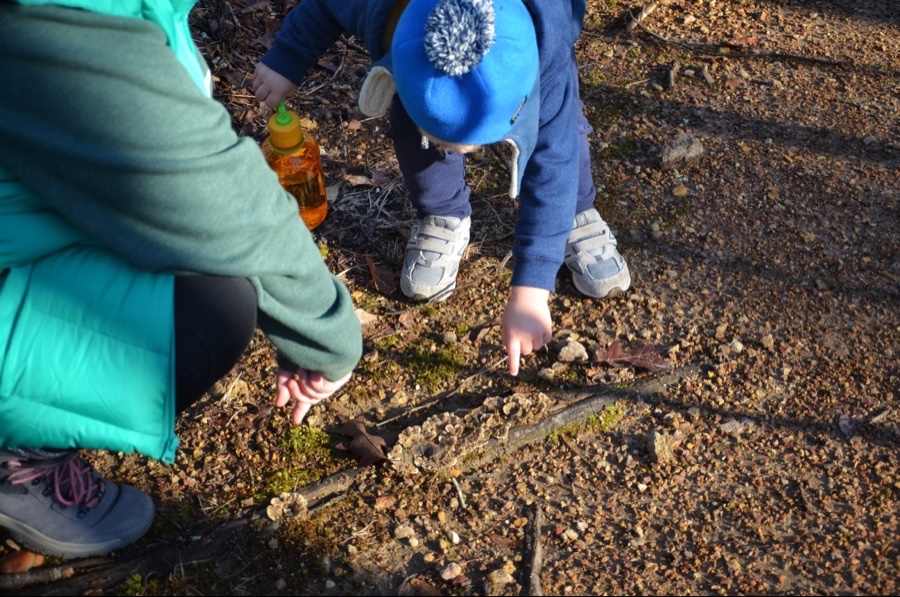
My son is two and a half. I’ve been doing this re-recreation of camp with him now for a couple months. But why now? He’s only two!
I know it’s time. I feel it deeply. And I’ll tell you why.
The Schooling Context in Our Society
In the U.S. the schooling needle is continually being moved younger and younger. Right before my son was born I was teaching college students who were preparing to be middle and high school teachers. These college juniors and seniors were taking a course on adolescent development from me in which we explored the relationship between human development and learning environments. One of our regular conversations was about how the curriculum for grades is being moved down so that what was taught in kindergarten or first grade 20 years ago is now taught in preschools, and that ripple effect is felt all through the twelfth grade. My mom has been a public high school educator for decades and has shared similar observations with me.
This pressure to “prepare our kids” leads to my being questioned all the time about when my son will begin preschool. Or assumptions about, “well when he starts preschool soon.” There’s a belief we need to start teaching our kids younger and younger. It’s become the cultural norm. The toys reflect it, the media reflects it, the stories reflect it, and the messaging reflects it. But here’s the thing: I don’t think it’s normal or a reflection of what young kids need. I don’t think it’s normal as an educator or as a human and I didn’t before becoming a mom. But what matter most for me right now is what I think of it as a mom, and I know it’s not right for my son to push him into these kinds of learning environments.
Re-creating Camp offers me a framework and more importantly a mindset to choose a different path. No preschool for us, we’re homeschooling for preschool and beyond. Most homeschool groups and curriculum don’t start for preschool age kids – because they don’t really need such a formal structure. But as that needle moves and the pressure to do preschool to prepare for the next thing get stronger, this helps me to maintain my conviction when confronted with others’ opinions.
We’re Designing Our School Culture
By starting now, we’re laying foundations and rhythms we can continue to build upon for years to come. I’m using this time when he’s so little to brush off the dust and bust off the rust on my camp memories to think about what the design might look like in a few years; and what I can do now to lay foundations that will help us grow into those future ideas.
In teaching and learning there’s a concept called scaffolding. Essentially, it’s the idea you can’t go from zero exposure to a concept, like geometry for example, without building stairs to walk climb toward the more complex ideas. Learning also isn’t linear. Learning requires some opportunities to go up and down and test and pause. Scaffolding helps instructors build in those opportunities as well as find moments in the learning to either support the learner or give them more autonomy. Without scaffolding most learners won’t retain, they’ll just regurgitate and then dump the information. But when I was studying learning I began to really understand scaffolding does a whole lot more than just help with content acquisition.
Learning environments designed with scaffolding are more empowering for learners. To feel empowered in learning an individual needs to build self-efficacy; a close cousin to confidence, self-efficacy is the belief a person has in themselves to eventually be successful. Scaffolding helps to foster self-efficacy.
By starting to re-create camp for my son now, sooner than people might say is necessary, I’m building those first steps I’ll scaffold onto later. As we practice what “campschool” looks like, he’s building self-efficacy but he’s also learning how I’ll behave as his teacher/camp coulnselor/mom. I know it will pay off in two years, seven years, and twelve years to have established these rhythms and dynamics early on. I’m creating a consistency he’ll be able to trust throughout his whole education.
For My Own Development as a Mother
Motherhood is hard. But not just for the reasons the memes on social media gripe about. Motherhood is hard because you go through a major developmental shift; your identity changes and you’re flung into a role you have no training for and sadly, in our culture, very little support for while also being judged by strangers and family/friends alike. Motherhood in our culture tells us to be supermoms but we’re human and we don’t have the help and care from communities the way mothers throughout history have had. We’re isolated in our units and the expectations on us are huge even though most people who levy those expectations on us aren’t familiar with our context, values, resources, or challenges.
For the first year-and-a-half of my motherhood this weighed so heavily on me. I knew I wanted to raise my son differently but I struggled to express my convictions. I knew I wanted to walk away from my career and the learning sciences program I was studying in but I felt I’d be pitied. I knew I wanted to give my heart for empowered learning but I didn’t know how, and feared I wasn’t good enough. Then I read two books that challenged me to do it my way, and now, for me. The Call of the Wild and Free by Ainsley Arment and 1000 Hours Outside by Ginny Yurich. I was so inspired I decided I don’t need to wait until he’s kindergarten age and I don’t need to belittle what is the right path.
Camp.
Camp is when I was my best self. Camp built the best foundations for me. Camp aligns with my family’s values and the homeschool values we want to have. Camp is also easy to re-create, for me, and I needed to build confidence in my self so badly.
When we started, the shift was almost immediate. My son started to thrive. Our relationship blossomed. I started to feel my best qualities rising to the top. We have so much fun and his growth in language, numbers, nature, and life has expanded exponentially. I’m not sitting teaching him his alphabet or counting with him; I’m taking him on hikes, and we’re making food and art together. That’s it. Each month I pick a theme (we had themed weeks at camp – more on that in another post) and we read books related to it and go on field trips to places where we can dive in. We immerse in an idea or two each month. We have a rhythm to our days, like we did at camp – more on that in another post too – and we spend tons of time outside in our yard. That’s it. So simple. But what it’s done is grounded me in my competence. It’s empowered me.
Presence
The final reason to do this now is because I wanted to be more present. Lots of homeschooling folks will encourage no preschool, just let them play. But I’d find myself disengaging with my son day-in-and-day-out. Re-creating camp is keeping me where my feet are. It’s drawing me in an reminding me why I’ve made these choices to be a stay-at-home/homeschool mama. I don’t need to wait to be that mom, I’m that mom today. The more present I am the better I feel, the better our days go, and the more he thrives. My phone is down. My lanyard is out – more on that in another post too! – and we’re living and learning together.
Why on earth would I wait for that until he’s five!?
Now is the time. This is the place. I don’t need to wait for later or want for more. I can re-create camp for both of us, here and now, and so I will.
Originally posted 10/9/22 on old website
 recreatingcamp.com
Leave a comment