
Tricks to read more with your kids and yourself
“How do you read so much?”
I get asked this a lot. I’m a stay-at-home mom and I have a boy who has a ton of energy, passion, and no siblings!
This question is asked in multiple ways. I get asked, “how do you read so much?” in relationship to reading aloud with my son, especially because he has so much energy people are surprised to hear he sits and listens to so much reading aloud. I also get asked, “how do you read so much?” about my own personal reading, especially in relationship to reading lots of homeschooling books.
So today, I’m spilling the beans. I’m telling you how I do it, my tricks for both reading a lot with my son and reading a lot for myself.
Building a habit of reading aloud with your kids:
1. Prioritize it:
First and foremost, it has to be something you choose to prioritize. There are more things to do and more things to give attention to than there are hours in a day. Especially when you homeschool. So, we have to prioritize and when we prioritize, we are not just saying “this thing is very important” we are also saying, “I’m willing to sacrifice that other thing to emphasize the importance of this thing.” Very early on, before we’d even fully decided to homeschool, my husband and I decided we had two priorities we would always elevate over other things: reading aloud with our son daily and being outside daily. This isn’t to say other things aren’t important but we would sacrifice other things to guarantee these two things.
Knowing so clearly these are the priorities, the habits our homeschool is built upon, makes it easier for me to make the decision to read aloud. Do I read aloud or do the dishes? Read aloud. Do I read aloud or do a lesson on ABC’s? Read aloud. Do I read aloud or write a blog post? Read aloud. It’s not to say I don’t see value in the other things, and I won’t get to them eventually, but I don’t even have to really think about it because I know where my priorities for our homeschool are: reading aloud and being outside. It’s now so ingrained I don’t actually have to go through the decision-making process; I just execute. No decision fatigue here. Reading aloud has become a default choice.
2. Make it easy:
No matter where we are in our home, there is a book nearby. There is actually a stack of books nearby. I never leave the house without a couple. There is always a book within reach – not only of my own hands, but also of my son’s hands. So it’s not just easy for me, but it’s also easy for him to grab a book and hand it to me, and I know what that means!
3. Keep like-books together in different spaces:
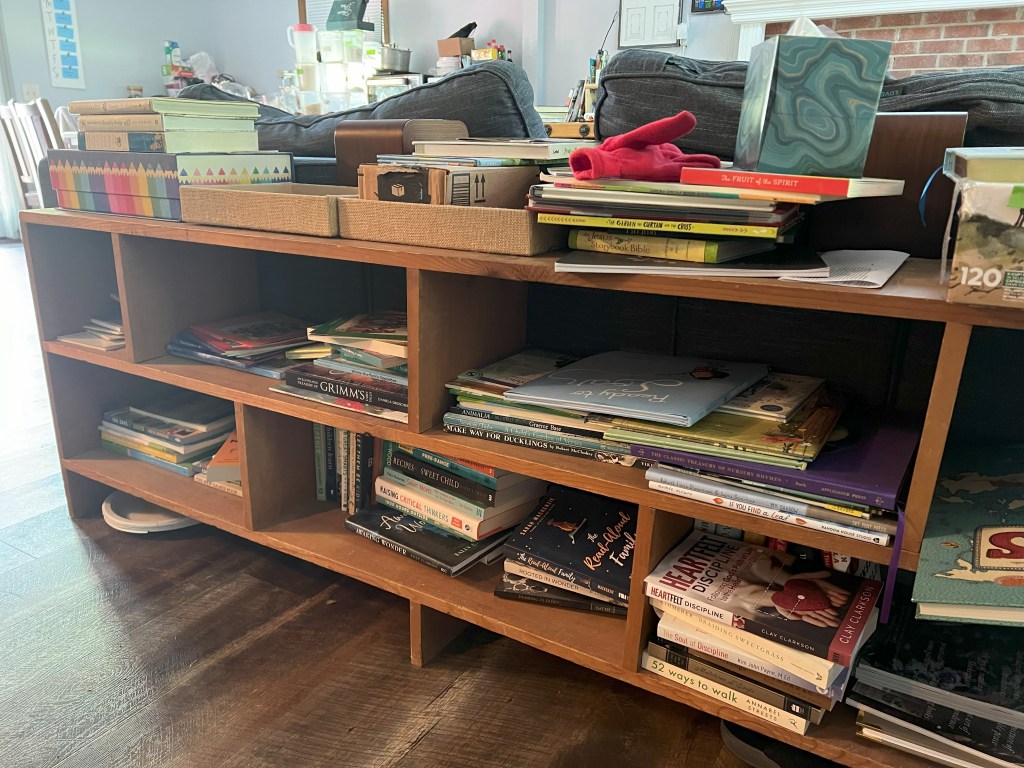
This is one I didn’t see coming but it is a game changing. Part of our gentle homeschool preschool (see this post for more on that!) is to read aloud daily in the morning after breakfast. All of the books I’d consider part of our “homeschool literature” live on a bookshelf next to our couch. It’s easy to gravitate right over there after breakfast. All the books I want him to read, to lay a beautiful foundation of amazing books, are right there: Peter Rabbit, Winnie-the-Pooh, Brambly Hedge, James Herriott’s Treasury for Children, and more. Plus, the books for each month’s theme (again, see my preschool post for more on this).
We also have a playroom in the basement of our home. There, among the tractors and legos are more books. These might be qualified as less educational and more entertaining, but no less valuable. Here’s where Little Blue Truck, Katy, The Berenstein Bears, Little Owl and others hangout. There are also small shelves in my son’s room for bedtime books, which can include any books from anywhere in the house he’d like to bring there, as well as some classic bedtime books like Goodnight Moon.
This is a good time to discuss books considered “twaddle.” If you aren’t familiar with the Charlotte Mason movement of homeschooling, allow me to quickly summarize a debate that is occurring within the movement. Charlotte advocated for reading our children excellent quality books, living books she called them, as we educate our children. One of the points she was making was, particularly when learning about a specific event in history or real-lived experiences, children will learn better from a story, an account, a beautifully written narrative, than they will from a basic, boring textbook approach. She also advocated for reading children excellent literature, because we want kids to be exposed to eloquent prose and properly produced sentence structures. There is true beauty in those phenomenal pieces of literature. She called other books twaddle. Over a hundred years later what’s erupted in the Charlotte Mason homeschool community is an argument of what constitutes living books and what constitutes twaddle and whether you should ever let your children read twaddle. Here’s my take: we need all kinds of books. Only you can decide what’s right to expose your kids to and what constitutes books “good enough to be on your shelf.” As someone who writes and has taken writing classes, I know how valuable it is to be exposed to the “best words.” But I also know how sometimes I need a book to simply be entertainment, an escape, silly, and not be hard to read! I want my son to know books can be for deep learning and superficial entertainment. I’d rather he grabs a book someone else might call twaddle than a lot of the alternatives out there, especially as a boy. But I also like to help him make the distinction between a book we’re reading for it’s eloquent prose or excellent storytelling, and a book we’re reading because it’s just plain fun. I believe, we need both.
Keeping books in these places helps make that distinction without needing to be snobby about it. It also helps set my read aloud mindset. What are we trying to accomplish here? Does he just need some entertainment? (I do some pretty fun voices). Or is this about our rhythm of connection? Or is this a story I want to sink in and build on for years of education to come? I need the distinction too.
4. I force consistency, not the length of engagement
When it comes to reading aloud together first thing in the morning, all I require is one. Either one book, or one story out of an anthology. I have the options available for my son, he knows which books are long and which are short, and he chooses what we’re going to read each day. Sometimes he brings me one short book. Sometimes several short books. Sometimes he brings me an anthology and wants just one story out of it; other times he wants five. Somedays he wants one story out of several different anthologies. But he decides how long we’ll read. All I do is remind him, after breakfast we read together. There are days we read for five minutes and there are days we read for an hour. He’s four. I let him guide the length but I hold the habit.
5. I always say yes:
As I mentioned, there’s always a book in reach wherever we are, whatever we’re doing. If he asks me to read, I say, “yes.” Now I should qualify the word “always.” Last week I was sick and lost my voice, I didn’t say yes every time. But that’s a special condition. Usually, I say, “yes.” Whatever I’m doing, I put it down and read. However I feel (unless it’s sick), tired or grumpy or whatever, I put it aside and read. Can I tell you something? Whatever else is going on, however I felt before I read, I always feel a little better, a little lighter, a little more joyful after reading aloud with my son. Why? Because it’s a source of connection for us and our relationship makes me feel better than just about anything else in the world. It’s also a way for him to signal to me he needs connection. “Mommy, will you read this to me?” is often what snaps me back to the present moment. Other times he is just in the mood for a story. No matter what though, I know it communicates something major to him to know, Mom says yes to reading, to sitting together, to connecting over the power of a beloved story. I didn’t know I’d be communicating these things to him when I started reading aloud but now that I know, I’m so grateful this is such an intrinsic rhythm.
What I love so much about reading together is it’s a way we can pay attention to where our feet are while simultaneously embarking on an adventure in our minds.
Building a habit of reading with yourself (these will sound familiar!):
1. Prioritize it:
If you don’t have it in your mindset to read, you won’t. If you speak things like, “I’m not a reader,” or “I don’t have time to read,” then those things will be true. If you want to do something, you have to make space for it and not just the physical space but also the space in your mindset. It’s like any habit, if you don’t frame it positively for yourself, then it’s going to be a struggle.
When I turned 40 I decided I wanted to shift my attention away from watching so much stuff to reading more, in part to model something I value to my son but also because I could feel myself becoming a zombie. I was re-watching old TV shows I’ve already seen and it was breeding disconnection and exhaustion. I wanted to get my phone out of my bedroom at night. So, I prioritized reading. I replaced my phone with a book on my bedside table. I started leaving my phone inside and bringing a book outside with me. I put reading books above watching stuff. But it took intentional thought and direct changes. If I hadn’t taken those steps, it wouldn’t have jumped up the priority list.
2. Make it easy:
I recently realized I was being a snob about audiobooks. But while reading The Read Aloud Family by Sarah Mackenzie she talked about the benefit of read alouds well into teenage and adulthood. It made me realize, we all like to be read aloud to and that should include adults! If you are more likely to get into a book if it’s read to you, do it! Make it easy. And much like my kiddos books, I place books within my reach anywhere I am. I have a stack on the bookshelf in the living room, a few in his playroom, one or two by the door (so it can go outside with us or into my bag because I always bring a book with me when I leave the house), and several on a shelf in the bedroom. Put the book between you and the other choice you could make: between you and your TV’s remote or between you and your phone’s charger. Whatever it is you usually reach for, place a book there too. Make it easy to grab the book. Make it easier to grab the book than the other things. When it’s easy to grab or listen to, you’re more likely to develop the habit.
3. Keep like-books in different spaces:
I devour homeschool books. I treat learning about homeschooling as “honing my craft.” Here’s my secret: when I’m with my son, those are what I reach for. If he’s going to freeplay or we’re heading outside for a few hours, then I grab whatever homeschooling book I’m currently reading. Here’s why: I’m already in my homeschool mom headspace so it’s easy to jump into it and it’s easy to jump out of it. When he calls out, “mommy, come play with me,” or “watch this,” I’m already reading a book encouraging me to engage with him and prioritize our relationship over other things, so it’s easy to pause and think, this book can wait. These books live on the same shelf as all his homeschooling books! I keep my books on faith or self-growth on a side table where I spend our afternoon quiet time or in the playroom where we spend evening family time. We don’t allow anyone, adults included, to use screens in the playroom so my husband I both always have a book in hand in case our son wants to play alone or with the other parent in our time between dinner and bed. And I keep my entertainment books in my room where I read before bed. Some of these books are pretty twaddle-ish! And that’s okay. They have their place and when I keep my books grouped together with like-books it helps me know how to engage my brain in the moment. Again, it takes some of the thinking out of it but it also matches my reading energy to the spaces I’m in.
This does mean I’m reading several books at a time. I’ve always read this way. If you haven’t, I encourage you to try it because it keeps your reading momentum. Not feeling the book you’re reading on self-growth? Just go grab that homeschool book you were super into reading earlier in the day. Not loving your fiction book this evening? Go grab the one on a relationship with Christ that was super engaging this morning. Having multiple books going, in multiple spaces means, even when my reading headspace doesn’t align with my reading physical space, there’s always a book somewhere nearby I can grab and keep reading through.
All of this keeps me from making a choice to do something other than read.
4. Force consistency, not the length of engagement:
I bring a book with me everywhere I go and read at least one page while I’m out, even if it’s in my car after I’ve parked back at home. I make lugging that book around with me everywhere matter. I always bring a book outside with me, even if I think my son will want to play with me the whole time. I read at least one page before bed, so the last thing I look at is always a book – even if I was breaking the rules and on my phone for an hour before bed. I offer myself grace without breaking the habit. I bring myself the consistency, but if I can’t get into it, I let myself let it go. If it feels like a chore, the odds are, I won’t keep doing it and neither will you. The same grace I give my son of saying, “we are going to read at least one thing after breakfast,” I give to myself: I’m going to read something today but also, if it’s not my day to get lost in a book and read several chapters, that’s okay.
5. Always say yes:
If there is a new book, a new series, an author I get exposed to, I say, “yes.” I add it to a list. I put it in my cart so I won’t forget. I search for used copies. I ask my library to order it. And, I say yes to books over other things. I put more emphasis on my book budget than my other entertainment or necessities budget. I say yes to books. In any way I can.
In saying yes to books I’m making space for them. And, it feels like a commitment. I bought this book or I made space on the shelf for it, and I need to honor the commitment. When I say yes to books, I’m also saying no to other things. This becomes a self-fulfilling cycle of reading. I chose books over other options and therefore, I will read them.
One other rule I have for books for both my son and myself: if you aren’t enjoying it, you can stop. Look, not every book is going to be for your child (even some of the good books!) and not every book is going to be for your family (values first!) and not every book is going to be for you (even the book your bestie loved) and that’s okay! There are so many books to be read and making time and space for reading does take intentionality so if a book is not adding value to your life, I beg of you, stop reading it! Make space for the ones that make you laugh, make you cry (in a good way), teach you something, and help you grow. And teach your children to do the same. I sincerely believe so many struggle with reading habits because of being forced to read something we didn’t enjoy, or worse, made us feel awful. If the goal is to read more (and I’ll share with you my actual goal below), then we can’t force ourselves or our kids to read things just because we said we’d read it.
Here’s my actual goal for everyone in my house because it isn’t to read a lot or even love reading: I want us all to love books. That’s it. Maybe listening to audiobooks is better for one of us. Or reading entertainment-type books instead of classic literature fits best for someone in our home. Or books on self-growth or books on specific interests rather than stories light one of us on fire. As long as everyone in my home loves books, loves to get immersed in them and feel themselves changed by them and explore something they’d never considered and sees the world a little differently and ultimately feels closer to God through loving books and loving His book most, then, I’m satisfied.
How do you tackle, or will you begin tackling, loving books in your home?
Originally posted 4/24/24 on old website
 recreatingcamp.com
Leave a comment