
The best of both worlds
There appear to be two camps in the homeschooling world about preschool. One says we should do nothing except let them play! Piaget said, “play is the work of the child” and there is great evidence of the benefits for making abundant room for play in our children’s day-to-day rhythms. Advocates of the “just let them play” camp suggest there is no need to rush childhood and our three-to-five-year-olds don’t need to be hurried into formal learning. The second camp says we should purchase curriculum to help build some learning foundations or send them to a preschool with a philosophy aligned with our homeschool values (like a forest preschool or a Montessori or Waldorf school). “The goal of early childhood education should be to activate the child’s own natural desire to learn,” Montessori said and this notion is at the heart of many homeschooling families’ intention for choosing to home educate. Advocates of these preschool pathways suggest this helps children develop the skills needed to learn once the formal elementary years begin.
I often see parents asking what they should do for homeschool preschool in the forums and groups I’m in online. Every time a debate erupts in the comments about which camp is right – just let them play versus do a curriculum/outside the home preschool. It never feels as helpful or supportive as it could be of the original posters’ needs and concerns. We have to remember the cultural landscape within this question is being asked (at least in the U.S.). Parents who have chosen to homeschool are often bombarded with assumptions about delayed learning and a lack of socialization; these concerns (whether valid or not) lay alongside a path of increased “readiness” and preparation for kindergarten. Pre-K (which is relatively new) is now considered “required” to be able to enter kindergarten (even in places where neither Pre-K or kindergarten is compulsory). The things once taught in kindergarten are being taught in preschools. There is a cultural sense of “the earlier the better” and anyone who has had a preschool-aged child in the last ten years and hasn’t sent their child(ren) to preschool knows there is a pressure – sometimes spoken, sometimes not – when your three-year-old doesn’t know their ABC’s but your best friend’s three-year-old (who attends preschool) does.
Let me be clear, I’m a proponent of delaying formal education and keeping the pressure off our kids (and ourselves, if we can manage!). When I was studying learning sciences, I often heard from professors with elementary teaching backgrounds, and from the pre-service teachers we were preparing in the education department, how much sooner kids are expected to grasp concepts today than they were twenty or thirty years ago, “when we were kids.” Furthermore, there is absolutely no evidence this push to teach concepts sooner has any benefit for these kids down the road (and there is starting to be evidence of the opposite as homeschoolers are beginning to outpace conventionally schooled children – but there aren’t any studies…yet). In fact, the only measurable differences in kids today, who’ve experienced this push, are increases in mental health challenges like anxiety, increases in ADHD, and a greater expansion of the gaps between peers in classrooms (meaning there are more kids at the outlier ends of the learning spectrum). This may all just be correlation; it would need to be studied to actually assert causality. However, logic tells me kids who are pushed and rushed into things may likely develop anxiety. Logic tells me kids who didn’t get enough free-play when it was age and developmentally appropriate may have a hard time paying attention. And logic tells me it makes sense if kids are being presented with information sooner than it is cognitively appropriate, they may pressure themselves to excel, and more assuredly, they may not grasp concepts quickly enough to keep up with the same-age peers in their cohorts.
All this to say, I agree. With both camps actually. I don’t really think there are two camps here. I think Jean Piaget and Maria Montessori’s perspectives are blend-able (and I think they’d agree). I think the tension the two camps in homeschooling have is just the human tendency toward division and the tendency we have to dig our heels into what we’ve aligned with, and kind of disparage that which with we which haven’t aligned.
I wondered, mostly for myself and my kid, if there could be a delicate balance between the idea of letting them play and the idea of building some foundational building blocks during the preschool years that would prove useful for our homeschool in the future. Thus, the idea of a gentle homeschool preschool was born.
Over the last six and a half months we’ve been testing out a gentle preschool model in our home for our three- (almost four!) year-old son. It’s been working very well and so I want to share it with you. In fact, even as I’ve been navigating a severe medical complication from surgery, there has been so much benefit to having this gentle homeschool preschool design. It’s provided some consistency for us all in this challenging season and allowing us all to keep growing, ever so gently. It’s also allowing me to test out ideas I have of which style we’ll use when we are more formally doing homeschool. It’s easy to look at others homeschooling their older children and imagine the same approach in my own home in a few years. But the truth is, I’m not that mom and those kids aren’t my kid. I love that I’m testing these styles out now as opposed to when there is more pressure to be officially homeschooling.
Here’s what this has looked like:
Recreating Camp Gentle Homeschool Preschool
Themes (aka Gentle Unit Studies)
From the moment I decided to homeschool I was drawn to unit studies. It’s likely because they remind me of Camp Redwood. Each week we had a theme and the camp-wide field trip or celebration was theme-related. As leaders we were asked to plan some crafts, activities, games, experiments etc around those themes. Occasionally, we’d have guest presenters come to camp to share about their expertise related to a theme. And on Fridays we’d host a little talent show, called Redwood Roundup, and we were asked to prepare skits and songs related to the theme. My ideas about how we’ll schedule our weeks when we are officially homeschooling all come from this.
I love the interdisciplinary nature of unit studies. I fell in love with interdisciplinary learning through a couple important experiences in my life – but that’s a post for another day. The point is, this is how I want our homeschool to run, and I used this gentle homeschool preschool year as a way to test some ideas very lightly.
Last summer I planned out 10 themes, one for each month, September through May. For each theme I found (either in my own children’s library or purchased them) one or two books related to the theme. I’ll share our themes and those books at the end of this post. I also picked out four or five activities we could do related to the theme. Activities included arts and crafts, experiments, field trips, and life skills like planting or baking. This resulted in a ton of intentionality, but with lots of room for free-play and not feeling overscheduled. When we weren’t “studying” our monthly theme I was still looking for ways to point out what we’ve been learning about in the world, like showing my son a rainbow made by a prism while we’re out shopping, or showing him how big his shadow looks while we’re on a hike.
Gentle Morning Read Aloud
Each morning after breakfast we move gently into a morning read-aloud. We usually read one of our monthly theme books (unless we’re feeling a little burnt out on them) and then also read at least one other story. We love our anthologies like James Herriot’s Treasury for Children, Peter Rabbit and Other Stories by Beatrix Potter, The Complete Brambly Hedge by Jill Barklem, and Frog and Toad Storybook Treasury. We’ve also been loving Dandelion by Don Freeman, The Little House by Virginia Lee Burton, And Then it’s Spring by Julie Fogliano, to name a few. Sometimes he only has 10 minutes of reading attention and other mornings we sit together on the couch reading for over an hour.
This daily anchor has actually been a saving grace during my recent health trial. With as little as I can physically do, and how often I have had to scrap plans for art, experiments, and adventures, I’ve been able to keep this special time protected, sustained, sacred. It keeps us discussing our themes but moreover it keeps a beautiful relationship-building constant for us both. He craves it. And so do I. If I were to recommend implementing one thing from our gentle homeschool preschool adventure, it would be this.
Basic Skills
Last summer I attended the Southeast Homeschool Expo in Atlanta. I attended a couple of wonderful sessions with Susan Wise Bauer, who is well-known within the Classical style homeschool community. She’s a second-generation homeschooler and homeschooled four children. Her knowledge about education and learning is exceptional. I had the opportunity to discuss a few topics with her one-on-one. I shared with her my desire to craft our own curriculum and my homeschool intentions and she was very encouraging. I asked her opinion on what preschoolers need. While her answer gave a lot of space for each person to interpret and respond as individuals, she was very clear on three things she believes preschool aged children should be exposed to: basic phonics, basic numbers, and learning to draw circles in both directions. That last part was wildly intriguing to me. She explained how, whichever hand they become dominant in, they’ll need to be able to go either way to draw letters and numbers so developing the skill to go in both directions eases the learning curve later on.
I’ve taken her advice. We’ve gently introduced letters, numbers, and created lots of opportunities for drawing this year. Here are specific things we’ve done in each area:
Letters:
- I made our own alphabet sheets so each letter (for the most part – some are hard!) has images he knows and is interested in to color and have as exposure
- Hanging alphabet letters on the wall (I selected this pretty set from Coly Kuyper Art)
- Learning the alphabet song and a variation from Wild Pickle Press
- Lots of practicing spelling his name and writing it for him with his guidance
- Lots of drawing letters in chalk and guiding him to recreate them using sticks, or hop on a letter as I call it out
- Looking for letters on signs and buildings when we’re out and about
Numbers:
- Writing numbers on paper plates and taping them to the floor and asking him to step onto specific numbers
- Montessori manipulatives like a peg board counting game and sand paper numbers (both of which were gifts so I don’t have links – but this raises a great tip: ask for homeschool stuff as gifts!)
- Counting anytime we have more than one item. He got really into collecting acorns, so we counted a lot of those. We’ve also been counting flowers as we pick them, chicken eggs as we collect them, and always use baking and cooking as counting opportunities.
- Intentionally choosing books with numbers or counting in them
Drawing:
We’ve supported drawing by bringing crayons and blank paper to restaurants and getting a drawing tablet and always having chalk outside. When I see him drawing in a circle I always ask, after he’s had a chance to draw one way, “show me how to draw the same circle in the other direction!” My enthusiasm and curiosity motivate him and he does joyfully. It’s such a simple and easy thing to pay attention to, now that my awareness has been increased.
Emphasizing Rhythms
The other thing I’ve been gently doing this year is emphasizing rhythms. We talk about the seasons, the months, the days of the week. I made my own calendars of each (thanks Canva!) and magnets (thanks Shutterfly!) so he can move the corresponding magnets to the appropriate day of the week, month of the year, and season of the year. It’s very simple and a quick task. I just want to start getting him used to the fact we operate on these rhythms.
I further emphasize days of the week with our handful of activities: we do homeschool tumbling on Wednesdays, have a Wild+Free group meetup every other Thursday, and go to church on Sundays. This is more subtle reinforcement that each day has its own flavor.
Abundant Play, Exploration, and Curiosity
We spend the majority of our time in open play, and usually outside. In fact, my son has started to call this “work” and whenever I say, “let’s go out and play!” he corrects me.
“Mommy, it’s go out and work.”
I’m thankful my belief in play being the work of the child is coming through to him, and it seems this gently homeschool preschool has really highlighted this for him!
We’ve also organically started sitting in some spots regularly and talking about how things are different from these “sit spots” from day to day or week to week. This just started happening on its own and its been fun it started in spring. I was thrilled he naturally started doing this and also proud of myself for my awareness so I could encourage it!
Takeaways:
I’m loving this gentle homeschool preschool year. Particularly the relationships the way these small things have sustained us through a storm. It’s felt amazing not to push him to learn what other kids his age do in their preschool environments, but instead to go at his pace. It’s been awesome to follow his interest. For one month we were talking about spelling his name a lot. Then, that interest faded and he was more into counting, so I put my emphasis there too. Now he’s really into spotting letters, so I make sure to be ready when we’re out and about to point out signs with clear lettering. I feel highly attuned to him.
What’s more, I’m able to think forward with some new clarity. I can see how unit studies might work when he’s older with some actual experience to back it up. I see how he tends to learn best and am spotting his “great smarts.”. Additionally, I’ve been able to catch a glimpse of how I plan and execute and of course, how I adapt when I’m in a season of stress too. I’ve tested out my ideal schedule a little. And all the stakes for these tests have been extremely low! I feel like, when it’s time to formally begin homeschooling, I’ll have a good handle on how we both operate.
Next Year:
We will absolutely be doing another year of gentle homeschool preschool and I have every intention of keeping most things the same. The biggest changes are: 1. I plan to ask my son to help me choose themes and 2. I plan to involve just a sprinkle more exposure to phonics and numbers.
I hope this inspires you too. Like everything homeschool, my goal is to inspire you to design your own approach for your own family and home. Check out my guide on designing your own Gentle Homeschool Preschool. And reach out to me with any questions!
This year’s themes with books and example activities:
September: Rainbows
Books: All About Weather by Huda Huralji
Activity examples: Making prisms with crystals, stained glass rainbows
October: Trees
Books: Because of an Acorn by Lola M. Schaefer, The Giving Tree by Shel Silverstein
Activity examples: Apple picking, sponge painted trees
November: Leaves
Books: Fletcher and the Falling Leaves by Julia Rawlinson and If You Find a Leaf by Aimee Sicuro
Activity examples: Colored leaf art, leaf collection hike
December: Light
Books: When God Made Light by Matthew Paul Turner, What is Light by Markette Shepherd
Activity examples: Christmas lights drive (a family tradition anyways!), candlemaking (rolled beeswax)
January: Shadows
Books: My Shadow by Robert Louis Stevenson
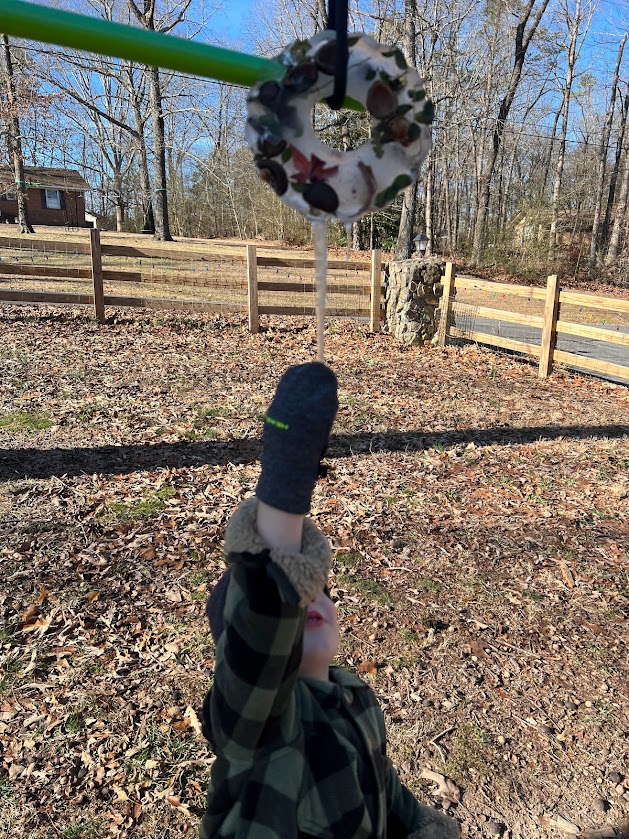
Activity examples: Hanging ice wreaths – one in full sun, one in full shade – to see which melts first, making a cardboard sundial
February: Rain
Books: Worm Weather by Jean Taft, Singing in the Rain by Tim Hopgood
Activity examples: Puddle stomping adventure, creating a cloud in a bottle
March: Flowers
Books: Miss Rumphius by Barbara Cooney, Over in the Meadow by Paul Galdone
Activity examples: Tissue paper flowers, planting native wildflower seeds
April: Dirt/Mud
Books: Wonderful Worms by Linda Glaser, Up in the Garden, Down in the Dirt by Kate Messner
Activity examples: Making mud pies, planting herbs
May: Clouds & Wind
Books: The Wind Blew by Pat Hutchins, Cloudy with a Chance of Meatballs by Judi Barrett
Activity examples: Flying a kite, writing a story about cloud shapes
Reach out to me for my Gentle Homeschool Preschool Gudie!
Originally posted March 2024 on old website
 recreatingcamp.com
Leave a comment